
Introduction
Ad hoc arbitration in India was expected to decongest courts and offer a self-contained mechanism for dispute resolution. However, the current landscape shows that the system itself has become burdened due to procedural delays, ineffective support mechanisms, and a lack of logistical capacity to conclude matters within statutory timelines.
Present Status: Pending Arbitration Matters in Indian Courts (2025)
Recent data reflects a significant backlog of arbitration-related matters across various levels of the Indian judiciary. In District Courts, there are approximately 61,573 arbitration-related cases pending, while the High Courts are dealing with around 13,597 such cases. The Supreme Court has a comparatively smaller but still notable pendency, with about 43 arbitration matters currently awaiting disposal. In total, Indian courts are burdened with nearly 53 million pending cases overall, highlighting the strain on the justice delivery system. Beyond the judicial system, an additional estimated 5 million+ arbitration matters remain pending in ad hoc or private proceedings outside the courts, further emphasizing the urgent need for reforms, streamlined procedures, and improved institutional support to reduce delays in arbitration resolution.
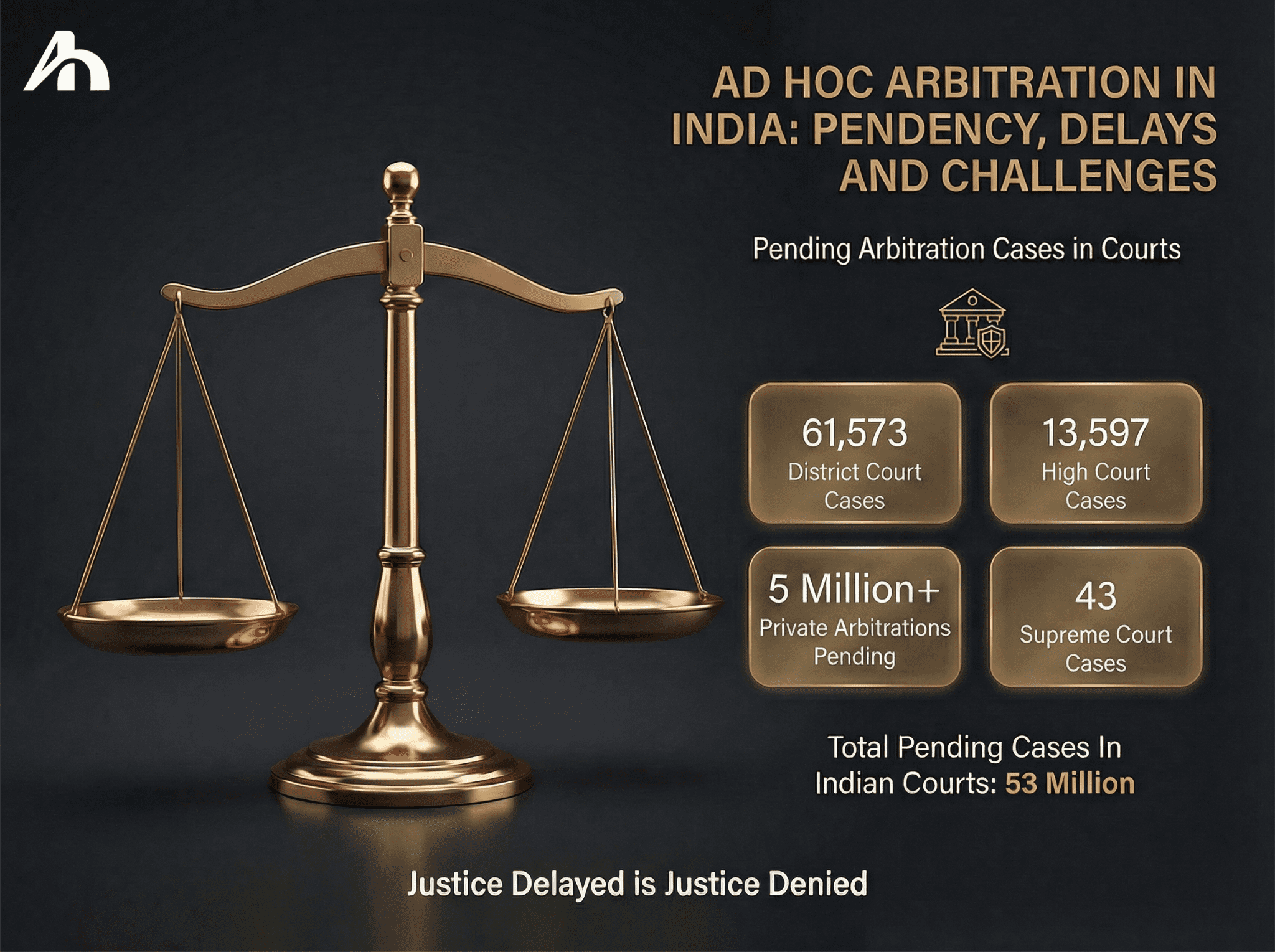
These figures reflect that ad hoc arbitration in India is not operating as a stand-alone mechanism and heavily relies on court intervention-particularly for appointment, challenge, enforcement, and appellate steps.
Judicial Concerns: Supreme Court on Delay in Arbitration Proceedings
In the recent ruling of M/s Lancor Holdings Ltd. v. Prem Kumar Menon & Ors. (2025), the Supreme Court expressed deep concern over the delay in arbitration proceedings, particularly where there is an inordinate and unexplained delay in the pronouncement of awards and progress of the arbitration process itself. The Court observed that such delays have deleterious effects on the very purpose of arbitration, which is conceived as a mechanism for swift and efficient dispute resolution. It noted that the passage of time debilitates human memory, impairs the recital of evidence, and creates unnecessary speculation and suspicion among the parties, eroding their confidence in the arbitral process. The bench emphasized that when arbitration loses its characteristic of speedy justice, it causes hardship to parties and undermines the fundamental objective of the arbitral system. In its strong words, the maxim “justice delayed is justice denied” applies equally to arbitral proceedings, and continued delays defeat the very essence of arbitration as an alternative to protracted litigation. Lawbeat
Why Ad Hoc Arbitration Faces Delay in India
Dependence on courts for appointment & interim orders
- Lack of fixed venues / logistical facilities
- Excessive adjournments and non-adherence to timelines
- Arbitrators handling matters like civil suits
- Limited monitoring of compliance with statutory deadlines
- Poor venue infrastructure and lack of internet/VC facilities, causing adjournments when parties cannot attend
Venue Availability and Its Impact on Arbitration Delays
As far as venues for ad hoc arbitration are concerned, the situation is largely unregularized. Availability is often irregular and unpredictable, while stakeholders may be available on weekends, many venues remain closed during weekends, wedding seasons, or other festive periods. This leads to unnecessary delays and frequent adjournments in arbitral proceedings, defeating the very purpose of arbitration as a speedy dispute resolution mechanism. To overcome these challenges, it is essential to have venues dedicated solely to arbitration, equipped with proper infrastructure and support. Platforms like Accordhub provide such professional spaces, ensuring availability, confidentiality, and full logistical support, including high-speed internet, video conferencing, and structured proceedings, thereby significantly reducing delays and inefficiencies in ad hoc arbitration.
Statutory Time Limits Under the Arbitration & Conciliation Act, 1996
Under the Arbitration and Conciliation Act, statutory timelines have been introduced to promote efficiency in arbitration proceedings. Section 29A mandates that an arbitral award must be passed within 12 months, and this period may first be extended by an additional six months with the mutual consent of the parties. Beyond this extension, any further enlargement of time requires the intervention and approval of the court. Section 11 provides that the appointment of an arbitrator should be decided within 60 days, preventing delays at the commencement stage. After an award is rendered, Section 34 states that any challenge to set aside the award should be disposed of within one year, ensuring timely post-award adjudication. Likewise, Section 37 mandates that appeals against arbitral orders must be concluded within six months, thereby supporting speedy appellate resolution and reinforcing the objective of timely dispute settlement under the arbitration framework.
However, due to pendency, lack of infrastructure, and procedural inefficiencies, these timelines are rarely met.
Need for Strengthening Ad Hoc Arbitration
- Fixed arbitration hearing rooms / venues
- Hybrid hearing systems to avoid adjournments
- Clear fee structure and case management framework
- Minimal court interference except where required
- Judicial monitoring of compliance with statutory timelines
Conclusion
Ad hoc arbitration in India is at a crucial stage. While the law prescribes strict time limits, the absence of practical infrastructure-venues, administrative systems, and technological support-continues to delay proceedings. Strengthening operational capacity is the key to making ad hoc arbitration effective, time-bound, and preferred within India.