

Ad hoc arbitration is a dispute resolution process chosen by the parties through an arbitration agreement. The arbitration agreement may be in the form of an arbitration clause in a contract or in the form of a separate agreement, which must be in writing, as recognized under Section 7 of the Arbitration & Conciliation Act, 1996. Since there is no institutional supervision, the appointments, procedure, hearing management and scheduling are all handled independently by the parties and tribunal within the framework of the Act.
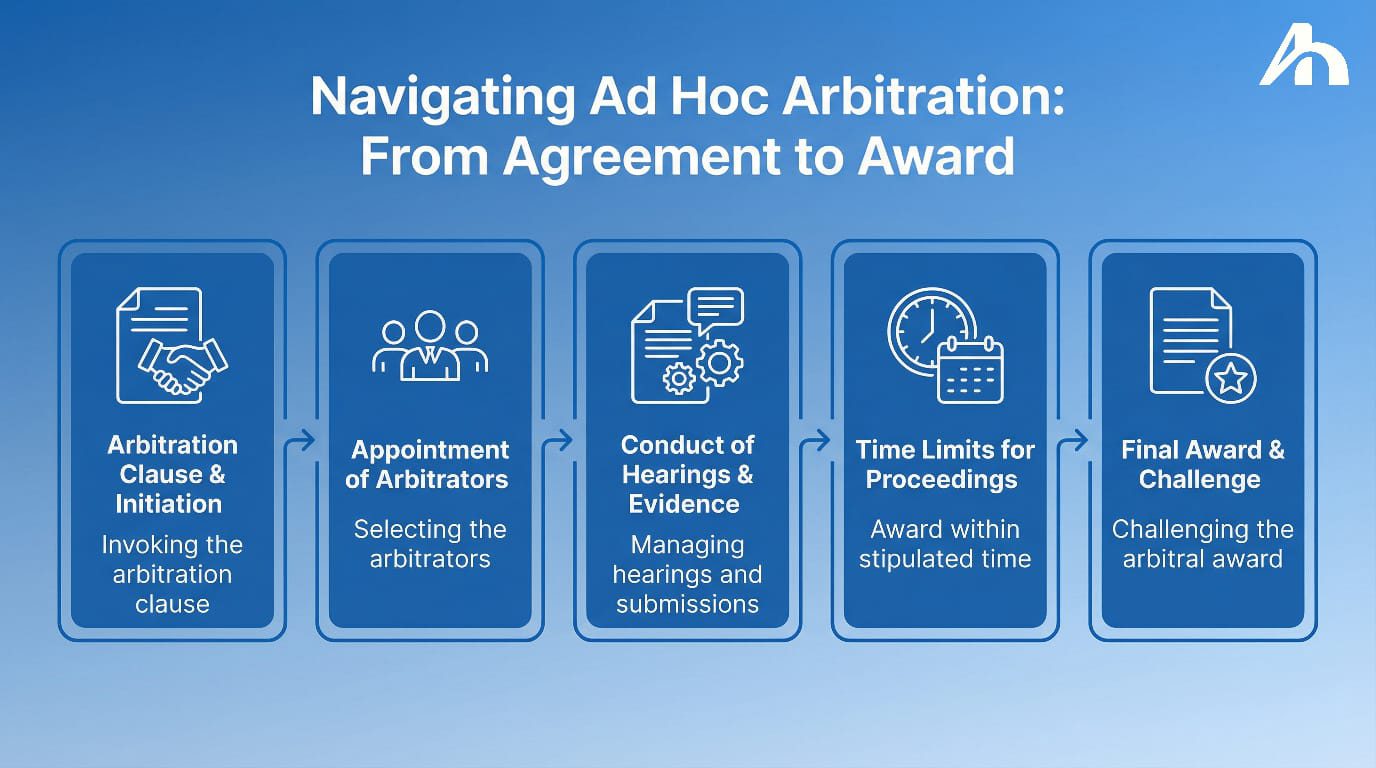
Arbitration Agreement & Initiation
Arbitration begins when a dispute arises and is invoked in accordance with Section 7 of the Act, which permits arbitration through a contractual clause or a separate arbitration agreement. Where such an agreement exists, proceedings commence upon issuance and receipt of a notice invoking arbitration under Section 21. In the absence of a prior agreement, parties may mutually agree in writing to refer an existing dispute to arbitration, and such agreement itself initiates the process. This framework removes the matter from civil court jurisdiction and allows private adjudication through the mechanism authorized by the Act.
Appointment of Arbitrators
Parties are free to determine the number, nationality, and procedure for appointment of arbitrators under Section 11(1) and 11(2). Failing such agreement, the statutory mechanism applies- in an arbitration with three arbitrators, each party appoints one arbitrator and the two appointed arbitrators jointly appoint the presiding arbitrator within the prescribed time under Section 11(3). In the case of a sole arbitrator, appointment is by mutual consent, failing which court intervention may be sought under Section 11(5). Where a party defaults, the agreed procedure fails, or an appointing authority does not act, a party may approach the Supreme Court or the High Court, as applicable, under Sections 11(4)-(6), limited to examination of the existence of an arbitration agreement. Section 11 thus ensures timely constitution of an independent and impartial arbitral tribunal.
Conduct of Hearings, Procedure & Evidence
Once the tribunal is formed, the parties are guaranteed equal treatment and a fair chance to present their case, a mandatory requirement contained in Section 18. The procedure is not bound by the Code of Civil Procedure or the Indian Evidence Act because Section 19 expressly permits procedural flexibility. Venue, jurisdictional seat and the physical or virtual location for hearings may be decided by agreement, or in the absence of agreement, by the tribunal itself, as permitted under Section 20. Further, oral hearings, documentary submissions, witness examination and cross-examination fall within the authority given to the tribunal under Section 24, and expert evidence may be sought under Sections 26-27 if necessary. Since ad hoc arbitration lacks any institutional support, the tribunal and the parties themselves are responsible for managing all logistical aspects, including scheduling, record-keeping, hearing venues, stenographers, and communications.
Time Limit for Completion of Proceedings
The Act imposes time discipline on the tribunal. From the date of completion of pleadings, the award should generally be delivered within twelve months, a requirement established through Section 29A(1). Parties may mutually extend this period by six months under Section 29A(3), but any further extension requires a court order under Section 29A(5), where the court may also replace the arbitrator if delay is attributable to the tribunal. Where parties seek a quicker resolution, they may adopt the fast-track process envisioned under Section 29B, targeting conclusion within six months from the tribunal’s constitution.
Final Award, Challenge & Enforcement
After completion of hearings, the tribunal delivers its award in writing with reasons, as required under Section 31. If a party wishes to challenge the award, it may do so before the competent court on limited legal grounds through Section 34, but if no challenge is filed within the statutory period or if the challenge is rejected, the award becomes enforceable as a court decree under Section 36. Certain orders connected to arbitration are appealable under Section 37, while others attain finality without further challenge.
Absence of Institutional Control & Resulting Difficulties
Ad hoc arbitration lacks any built-in administrative authority, which means there is no automatic case manager, fixed venue or support staff. These gaps often lead to delays in appointments, poor scheduling discipline, logistical challenges and difficulty in securing proper facilities. As a result, parties frequently return to courts either for assistance in constituting the tribunal under Section 11 or for extending time under Section 29A, making these two provisions the primary judicial touchpoints, when the parties are unable to agree or the process faces obstacles.
Practical Solutions for Procedural Gaps in Ad Hoc Arbitration
In ad hoc arbitration, because there is no institutional framework to provide procedural norms, the parties and the tribunal must determine procedure by agreement. While the Arbitration & Conciliation Act, 1996 gives this flexibility, in practice it can be difficult for parties to craft detailed procedures from scratch. To address this gap, many practitioners adopt established procedural frameworks such as the UNCITRAL Arbitration Rules by incorporating them by reference into their arbitration agreement or adopting them at the outset of proceedings. These rules offer a ready-made set of procedural guidelines ,covering timelines, hearings, evidence, and tribunal powers and are especially popular in commercial and international arbitration where both parties want clarity and predictability without joining an arbitral institution. SCC ONLINE
Conclusion
Ad hoc arbitration offers flexibility, privacy and reduced cost, but it demands responsibility from the parties. Proper drafting of the clause, timely appointment of arbitrators through the structure recognized in Section 11, observance of key procedural safeguards like those in Sections 18, 19, 20 and 24, and compliance with the time discipline prescribed under Section 29A are essential for efficiency. Without an institution supporting it, the Arbitration & Conciliation Act, 1996 itself becomes the backbone that carries the entire process from initiation to award and finally enforcement.